

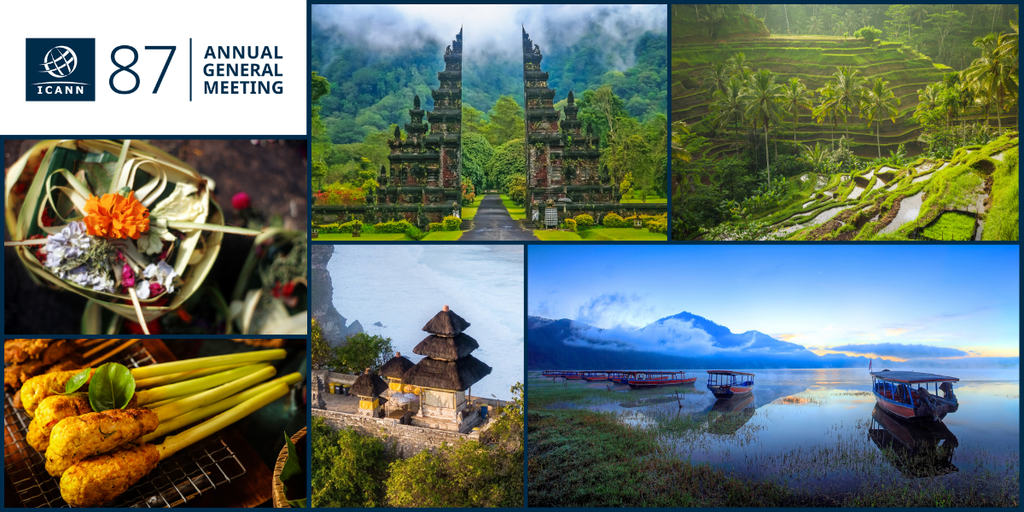
Bali, Indonesia, is a place where centuries-old traditions remain part of daily life. Temple ceremonies may occasionally stop traffic, intricate offerings appear outside homes and businesses each morning, and historic irrigation networks still shape the island's rice terraces. As the ICANN global community prepares to gather in Bali from 17–22 October 2026, here are 10 things to know about the history, culture, food, and landscapes of our host destination, and a few ideas for exploring them during your visit.
- Bali is not a city.
Although people often speak of "going to Bali" as if it were a single destination, Bali is both an island and one of Indonesia's 38 provinces. The province is home to the capital city, Denpasar, while areas such as Nusa Dua, Ubud, Sanur, Kuta, and Seminyak have a unique personality. They also may be farther apart than they appear: Bali traffic has a way of turning a short distance into an extended excursion. - Bali sits at the edge of two natural worlds.
Just east of the island, the Lombok Strait forms part of the Wallace Line, named for British naturalist Alfred Russel Wallace. On the opposite sides of this boundary, animal life changes dramatically. Bali's wildlife is predominantly Asian in origin, while the islands farther east lie in a transitional region where species of Asian and Australasian origin meet. - Daily offerings are an important Balinese tradition.
The flower-filled offerings often seen outside homes, shops, and hotels are called canang sari. These Balinese Hindu offerings, usually made from palm leaves and filled with flowers and other items, are part of daily religious practice and expressions of gratitude; take care not to step on or disturb offerings placed on the ground. - The subak system has shaped Bali's rice landscape for centuries.
Bali's terraces are supported by subak, a cooperative system through which farmers manage irrigation canals, water temples, planting schedules, and shared responsibilities. The system dates back to at least the ninth century. UNESCO recognizes it as an expression of Tri Hita Karana, the Balinese philosophy of harmony among people, nature, and the spiritual world. - Some of Bali's most famous landmarks are set in remarkable locations.
Tanah Lot appears to float offshore at high tide. Uluwatu Temple stands on a cliff roughly 230 feet (70 meters) above the sea. Both are particularly striking near sunset, although visitors will be sharing the view with crowds – and, at Uluwatu Temple, famously opportunistic monkeys. - A dance performance can involve an entire chorus becoming the orchestra.
In the kecak dance, a large circle of performers creates the rhythm through repeated chants rather than musical instruments. The performance draws on episodes from the Hindu epic Ramayana. One of the best-known versions is staged each evening at sunset at Uluwatu Temple's clifftop amphitheater. Tickets can sell out, so reserve ahead or arrive early. - Gamelan is an important part of Bali's musical traditions.
Gamelan ensembles, found in Bali and elsewhere in Indonesia, combine gongs, metallophones, drums, and other instruments in intricate, interlocking rhythms. The music accompanies temple ceremonies, dance, and theater throughout Bali. Visitors can hear a live ensemble during many of the traditional evening dance performances in Ubud, including those held at Ubud Palace. UNESCO added gamelan to its Representative List of the Intangible Cultural Heritage of Humanity in 2021. - The gates that seem to frame a mountain have a name.
The split gateways commonly seen across Bali are known as candi bentar. They mark entrances to temples, palaces, and other compounds and are thought to resemble a single structure divided into two symmetrical halves. The design has become so closely associated with Bali that it appears throughout the island, including in modern buildings. - A unique twist on satay.
Unlike satay made with pieces of meat threaded onto a skewer, Balinese sate lilit is prepared by wrapping seasoned minced meat or fish around bamboo or a stalk of lemongrass before grilling it. Other local dishes to try include slow-cooked, richly spiced ayam betutu and jaje laklak, small rice-flour pancakes served with grated coconut and palm sugar. - Your visit helps support the island's culture and environment.
International visitors are required to pay a tourism levy of 150,000 Indonesian Rupiah (IDR) through the Bali Provincial Government's Love Bali program. The levy supports efforts to protect Balinese culture and the natural environment.
October also falls near the transition to the rainy season, so consider bringing lightweight clothing, sun protection, and a small umbrella. As visitors, please remember that many of the temples, ceremonies, offerings, and traditions you encounter are part of a living religious practice, rather than simply tourist attractions. Bali has far more to discover than any list can capture, so leave some room in your itinerary for the unexpected. We look forward to welcoming the ICANN community to Bali for ICANN87.